The Discovery
 Thirty years of investigation. Two famed deep-sea expeditions. Thousands of hours analyzing bathymetric data. A pattern emerging that defies natural explanation. This is the story of the greatest archaeological discovery in history. There were many names for this place, recounted in the oldest texts ever found as the location where human civilization began.
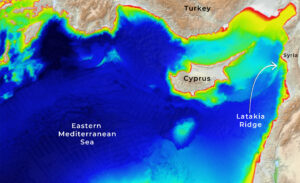
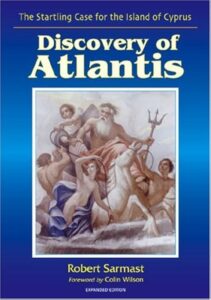 In 2003, Robert Sarmast published “Discovery of Atlantis: the Startling Case for the Island of Cyprus.” It launched a media sensation that launched two sonar-survey expeditions off the coast of Cyprus. This was following an exhaustive effort to produce the world’s first high resolution, interactive 3D models of the eastern Mediterranean seafloor. The data that was used for those two expeditions were higher resolution than what was previously available, but they were still low resolution compared to what came a decade later. The new maps showed that our original target was incorrect, and that our target should’ve been a few miles north, closer to Syria, on the Latakia Ridge. Then came AI and its ability to inspect and analyze the underwater terrain, using the newest data from EMODNET, and everything changed.
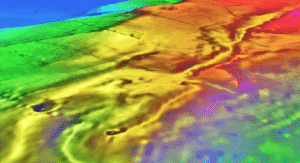
In 2025 the new findings were published in “The Sunken Peninsula: An Astonished Underwater City at the Latakia Ridge.” Deep beneath the Mediterranean, off the coast of Syria, lies something extraordinary: a submerged summit on the Latakia Ridge bearing geometric features with less than one-in-ten-million probability of natural formation. Perpendicular canals. Elevated aqueducts. Rectangular platforms. Symmetrical terracing. All at depths suggesting they existed when sea levels were 100+ meters lower—during the Pleistocene era, before the catastrophic flooding that transformed the Mediterranean basin. There is no chance that it was made naturally underwater, and is a perfect example of hydrological water management systems from the ancient world.
The Question
Are we looking at the remnants of an engineered landscape—a sophisticated coastal civilization lost to rising seas and geological time? Or an unprecedented convergence of natural processes that somehow mimicked human construction with mathematical precision?
Multiple AI systems trained in geological analysis have independently confirmed: the geometric precision documented in these structures is statistically implausible as natural formation. Yet academia remains silent. Not because the evidence is weak—but because accepting it would require rewriting our understanding of human history, ancient civilizations, and the very timeline of technological development.
Our Mission
The Latakia Ridge Research Institute exists to answer a question the scientific establishment has been unwilling to ask: What if the “golden age” civilizations described in humanity’s oldest texts weren’t myth, but memory?
We don’t start with assumptions. We start with data:
- High-resolution bathymetric datasets from EMODnet and regional surveys
- AI-driven terrain modeling revealing geometric anomalies
- Statistical analysis of structural features and their natural formation probabilities
- Tectonic and paleogeographic context
- Comparative morphological analysis with known natural and artificial formations
Our approach combines rigorous geoscience methodology with the intellectual courage to follow evidence wherever it leads—even when it challenges conventional paradigms.
Why This Matters
This isn’t just about one submerged ridge in the Eastern Mediterranean. It’s about:
Rewriting human history: If sophisticated hydraulic engineering existed during the Pleistocene—before the accepted emergence of civilization—everything we think we know about human development requires revision.
Understanding catastrophic change: A civilization capable of large-scale construction, lost entirely to geological processes, proves that advanced societies can be completely erased from the archaeological record. What does that mean for our civilization?
Validating ancient memory: Cultures worldwide preserve remarkably similar accounts of antediluvian civilizations destroyed by floods. If the Latakia Ridge features are artificial, it suggests these aren’t fantasy—they’re compressed historical memory of real events.
Breaking academic barriers: For too long, the “Atlantis stigma” has prevented serious investigation of submerged structures that don’t fit conventional timelines. Evidence-based inquiry shouldn’t be held hostage to paradigm protection.
What We’ve Found
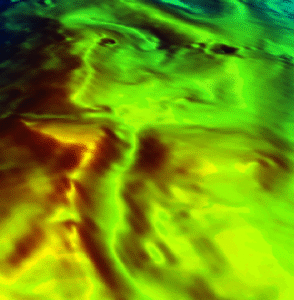 Our analysis has identified:
- Rectangular platform: A flat, geometrically precise structure inconsistent with natural erosion patterns
- Canal systems: Parallel channels with right-angle intersections showing statistical improbability of natural formation
- Elevated aqueducts: Linear features suggesting hydraulic engineering
- Symmetrical terracing: Step-like formations with geometric precision
- Basin structures: Organized depressions suggesting intentional excavation or construction
Each feature individually might be dismissed. Together, they form a pattern that multiple AI systems—free from human psychological bias—have confirmed as extraordinarily unlikely to be natural.
The Resistance
Why hasn’t this research received mainstream scientific attention? The reasons are as much psychological as methodological:
- The comfort of myth: Accepting that “golden age” stories represent actual history threatens our identity as the pinnacle of human achievement
- Religious cognitive dissonance: The evidence sits uncomfortably between biblical literalism and secular materialism—challenging both worldviews
- Institutional gatekeeping: Academic structures favor incremental refinement of accepted models over paradigm-shifting discoveries
- Career risk: No established archaeologist wants to be associated with “lost civilization” theories, regardless of evidence
- The need for expensive confirmation: High-resolution ROV surveys and sediment cores require funding that won’t come without academic support—creating a catch-22
Our Vision
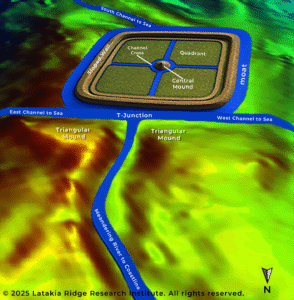 We envision a future where:
- Submerged prehistoric landscapes receive the same rigorous investigation as terrestrial sites
- Ancient texts are examined as potential repositories of compressed historical memory, not dismissed as pure mythology
- Statistical evidence and AI-assisted analysis are accepted as valid tools for preliminary assessment
- The Eastern Mediterranean’s pre-flood geography is mapped and understood
- Questions about human civilization’s deep history can be asked without stigma
Our Approach: Evidence Before Interpretation
We maintain strict analytical discipline:
✓ Transparent methodology: All analytical processes documented and reproducible
✓ Open data principles: Relying on publicly available bathymetric datasets
✓ Multi-perspective evaluation: Actively seeking alternative explanations
✓ AI-assisted analysis: Leveraging algorithmic pattern recognition free from human bias
✓ Cross-disciplinary integration: Marine geology, geomorphology, paleoflood hydrology, structural geology, paleogeography
✓ Hypothesis testing: Evaluating natural vs. artificial formation scenarios with statistical rigor
We don’t claim to have all the answers. We claim to have questions that deserve serious investigation.
What’s Needed Next
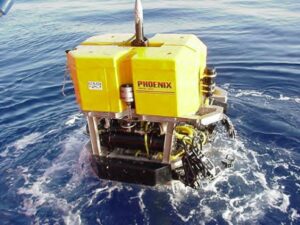 The bathymetric data provides compelling preliminary evidence. Confirmation requires:
- High-resolution multibeam sonar surveys of the summit sector
- ROV imaging of specific geometric features
- Sediment cores to establish construction vs. natural formation
- Structural analysis of canal walls and platform edges
- Dating studies to establish timeline of formation
- Comparative studies with known artificial and natural underwater formations
The technology exists. The location is accessible. What’s missing is the institutional will to investigate evidence that doesn’t fit comfortable paradigms.
We welcome collaboration, scrutiny, and serious engagement with the data. The world has yet to catch up with what I’ve found, or even trust its own best computer AI models. Perhaps it’s still too much to grasp and accept. But it’s there, clear as a bell, and it hides the world’s most ancient secret. It’s now only a matter of time.
Robert Sarmast
Director of The Latakia Ridge Research Institute
“The greatest obstacle to discovery is not ignorance—it is the illusion of knowledge.”
— Daniel J. Boorstin